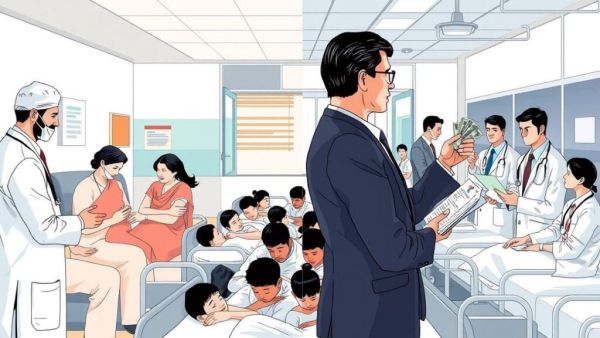
The country is celebrating the 76th Republic Day on 26 January 2026. On this occasion, the journey of India’s public health system is clearly reflected in the Union Budget figures. While the central government’s allocation on health was only around ₹2,000–3,000 crore, the amount for the Ministry of Health and Family Welfare has increased to around ₹1 lakh crore in the Budget Estimates for FY 2025-26. This increase is the result of policy reforms, major programs and efforts made during emergencies.
The journey of India’s Union Health Budget has been through major policy decisions, emergencies and structural reforms over the last two and a half decades. While the central allocation for the Ministry of Health and Family Welfare (primarily the Department of Health and Family Welfare) was just around ₹2,000–3,000 crore in 2000–01, this amount has increased to about ₹99,859 crore in the Budget Estimates for FY 2025–26. This increase is more than 12 times, which reflects the vast changes that have taken place in India’s public health system.
As per available data, India’s health budget
- 2000-01 (approx): ~2,000–3,000 crore (very low base, before big plans)
- 2004-05: ~8,000 crore
- 2006-07 (RE reported in PRS): ~11,366 crore
- 2011-12: ~26,760 crore
- 2017-18: Rs 47,353 crore
- 2020-21 (affected by COVID): BE ~53,000–64,000 crore (RE/actual much higher due to emergency spending)
- 2023-24: BE Rs 86,175 crore (Department H&FW); Ministry actual ~83,149 crore
- 2024-25: RE Ministry ~89,974 crore (Department H&FW RE ~86,582 crore)
- 2025-26: BE Ministry Rs 99,859 crore (Department H&FW BE ~95,958 crore)
Policy decisions played an important role in this growth. in 2005 National Rural Health Mission (Now National Health Mission) After its introduction, there was huge investment in rural primary health infrastructure, ASHA workers and infrastructure. in 2018 Ayushman Bharat Scheme under Pradhan Mantri Jan Arogya Yojana and Health and Wellness Centers The introduction of the Budget brought a new leap in the budget. PM-Jan Aushadhi Yojana A provision of ₹9,406 crore was made for 2025-26, which was 24 percent more than the previous revised estimate.
The COVID-19 pandemic pushed health spending to unprecedented levels between 2020 and 2022. Resources were mobilized on a large scale for vaccination, testing, treatment, oxygen plants and health infrastructure. During this period, Prime Minister Ayushman Bharat Health Infrastructure Mission was started.
If we look at the data, the Union health budget was only ~0.3% of GDP, in the early 2000s the total government health expenditure, including the Center and states, was ~0.9% of GDP. This has now increased to 1.3–1.5%+ in recent NHA estimates, with a higher contribution from the states. The share of public expenditure in total health expenditure has improved significantly, yet challenges remain.
On this Republic Day, when India is showing its democratic resolve and progress. From ending polio and expanding vaccination to building one of the world’s largest health coverage programmes, the health budget signals continued investment in human capital. With rising non-communicable diseases, aging populations and global health security needs, sustaining and accelerating this momentum will be critical to realizing a healthier, more equitably developed India.
President Draupadi Murmu will inaugurate the 16th National Voters’ Day celebrations!
Budget 2026: What is direct and indirect tax, what is the relation with inflation and market!
From Itanagar to Bengaluru, PM Modi lauds youth’s unique cleanliness initiative!
130th episode of Prime Minister Modi’s ‘Mann Ki Baat’, know 10 big things!
Contact to : xlf550402@gmail.com
Copyright © boyuanhulian 2020 - 2023. All Right Reserved.